If you’ve ever sat down to write a blog post and wondered whether you’re writing too much or too little, you’re not alone. How Long Should a Blog Post Be It’s one of the most common questions in content marketing: how long should a blog post be? The honest answer isn’t a single number — it depends on your goals, your audience, and what you’re trying to rank for. But that doesn’t mean there’s no data to guide you.
In this article, we’ll break down what research and search engine behavior tell us about ideal blog post length, and how to decide the right word count for your specific content.
Why Blog Post Length Actually Matters
Length isn’t just a vanity metric — it directly influences how your content performs. Search engines tend to favor posts that thoroughly cover a topic, because comprehensive content usually signals more value to readers. At the same time, readers themselves have limited attention spans, so padding a post just to hit a word count can hurt engagement and increase bounce rates.
Understanding how long a blog post should be means balancing two competing needs: giving search engines enough substance to recognize authority, while keeping readers engaged from start to finish.
What the Data Says About Ideal Blog Post Length
Multiple studies across the SEO industry have looked at the relationship between word count and search rankings. While results vary slightly by source, a consistent pattern emerges: longer, in-depth content tends to outperform shorter posts in search results.
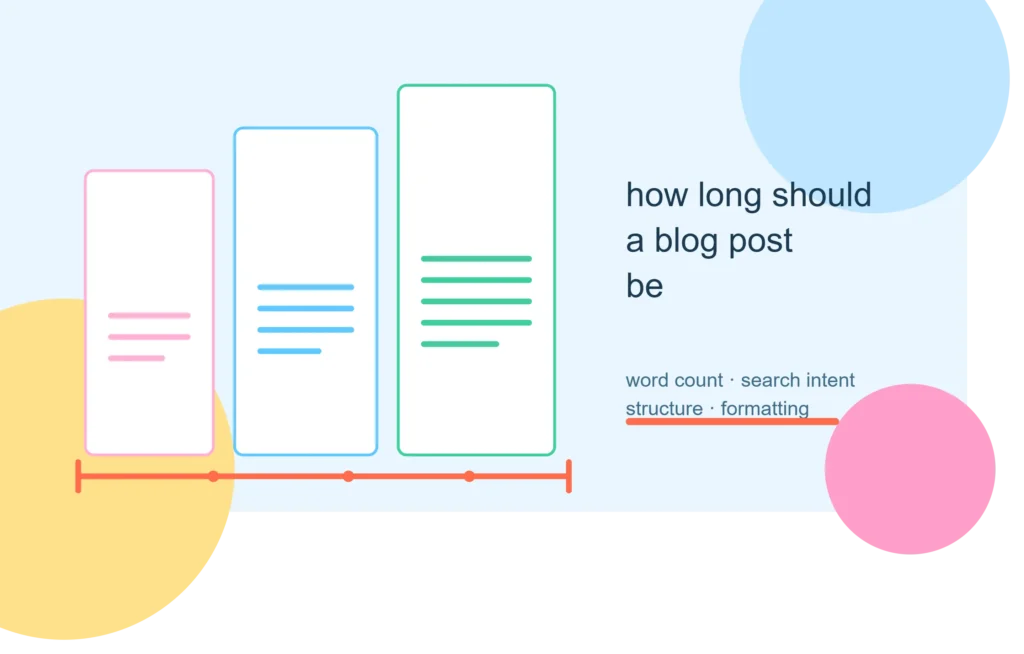
Here’s a general breakdown of blog post length by content type:
- Short posts (300–600 words): Best for quick updates, news, or simple announcements
- Standard posts (600–1,200 words): Ideal for how-to guides and everyday blog content
- In-depth posts (1,200–2,500 words): Strong for competitive keywords and comprehensive guides
- Long-form content (2,500+ words): Best for pillar pages, ultimate guides, and cornerstone content
Most successful blog posts targeting competitive keywords tend to fall in the 1,500–2,500 word range, but this isn’t a hard rule — it’s a general benchmark based on what tends to rank well.
Why “It Depends” Is the Real Answer
Despite the data, there’s no universal answer to how long a blog post should be, because length should always follow purpose. A recipe blog post doesn’t need 2,000 words of backstory before the ingredients list. On the other hand, a detailed comparison guide or tutorial often requires more depth to fully answer the reader’s question.
Before deciding on length, ask yourself:
- What is the reader trying to accomplish by reading this post?
- What are top-ranking competitors doing for this keyword?
- Can I add genuine value, or am I just adding filler?
- Does this topic naturally require more explanation, steps, or examples?
Search intent should always guide word count — not the other way around.
How to Determine the Right Length for Your Post
Instead of picking an arbitrary number, use a more strategic approach to figure out how long your blog post should be.
1. Analyze the Top-Ranking Competitors
Search your target keyword and look at the top five results. Note their approximate word count, structure, and depth. This gives you a realistic benchmark for what search engines are already rewarding for that specific query.
2. Match Content Depth to Search Intent
If your keyword suggests someone wants a quick answer, a shorter, punchy post may perform better. If it suggests someone wants a full walkthrough or comparison, longer content with more sections is likely necessary.
3. Prioritize Value Over Padding
Never stretch a post just to hit a target word count. Search engines and readers can both detect filler content, repetitive phrasing, or unnecessary tangents. It’s better to write a focused 900-word post than a bloated 2,000-word post full of fluff.
Signs Your Blog Post Is Too Short or Too Long
Sometimes it helps to recognize the warning signs on either end of the spectrum.
Your post might be too short if:
- It leaves obvious questions unanswered
- It lacks examples, data, or supporting detail
- Competitors ranking above you are significantly more comprehensive
Your post might be too long if:
- You’re repeating the same point in different words
- Sections feel disconnected from the core topic
- Readers would need to skim heavily just to find useful information
Formatting Matters as Much as Word Count
Regardless of how long your blog post ends up being, formatting plays a huge role in readability and engagement. A 2,000-word post broken into clear H2 sections, short paragraphs, and scannable lists will almost always outperform a dense wall of text at the same length.
Best practices for formatting longer posts include:
- Using descriptive H2 and H3 headings to organize sections
- Keeping paragraphs to three or four sentences
- Adding bullet points for lists, steps, or comparisons
- Including relevant images or examples to break up text
Good structure makes even long-form content feel quick and easy to read.
Also Read
How to Write a Blog Post That Ranks: A Practical Guide
Final Thoughts
So, how long should a blog post be? The real answer is: long enough to fully and clearly answer the reader’s question — and not a word longer. While data suggests that 1,500–2,500 word posts often perform best for competitive topics, the right length always depends on your specific keyword, audience, and content goals.
Rather than chasing a magic number, focus on delivering real value, structuring your content clearly, and letting the topic itself dictate the length. When you do that, your blog post length will naturally align with what both readers and search engines are looking for.