Picking from the best platforms to sell online courses is one of the biggest decisions you’ll make as a course creator — Best Platforms to Sell Online Courses in 2026 and it’s a decision that can quietly make or break your income. The right platform gives you the tools to market, deliver, and get paid for your knowledge without friction. The wrong one buries you in fees, limits your branding, or leaves you fighting clunky software instead of focusing on your students. This guide breaks down the top contenders so you can choose the one that actually fits your goals.
What to Look for Before Choosing a Platform
Before comparing specific tools, it helps to know what actually separates a great platform from a mediocre one. Not every course creator needs the same features, but a few factors matter across the board:
- Pricing structure – monthly subscription vs. revenue share vs. one-time fee
- Marketing tools – email automation, affiliate programs, sales funnels, coupons
- Course design flexibility – drip content, quizzes, certificates, community features
- Payment processing – how fast you get paid and which countries are supported
- Audience access – do you bring your own traffic, or does the platform bring buyers to you?
Keeping these criteria in mind will make the platform comparisons below far more useful, since the “best” option really depends on which of these factors matters most to you.
1. Teachable — Best for Beginners Who Want Simplicity
Teachable has built its reputation on being approachable. The drag-and-drop course builder requires no technical skills, and the checkout process is smooth for both creator and student. You get full control over pricing, coupons, and branding, along with built-in tools for quizzes, compliance certificates, and drip-fed content.
Teachable charges a monthly subscription rather than taking a large cut of every sale, which makes it especially attractive once your course starts generating consistent revenue. It’s a strong pick for creators who want a clean, no-fuss setup without diving into complicated tech.
2. Thinkific — Best for Course Design Flexibility
Thinkific stands out among the best platforms to sell online courses when it comes to customization. It offers a highly flexible course builder, supports multiple content types (video, text, downloadable files, surveys), and allows deep branding control through custom domains and themes.
Thinkific also has a generous free plan, making it a smart starting point for creators who want to test their course idea before committing financially. As your course library grows, you can layer on advanced features like memberships, bundles, and community spaces.
3. Kajabi — Best All-in-One Business Platform
If you want more than just a course host — think email marketing, landing pages, sales pipelines, and even a built-in CRM — Kajabi is built for that. It positions itself less as a course platform and more as a complete online business operating system.
The tradeoff is price: Kajabi sits at a higher tier than most competitors. But for creators who want to consolidate multiple tools into one dashboard instead of juggling separate software for email, funnels, and hosting, the investment often pays for itself in saved time and simplified workflows.
4. Udemy — Best for Built-In Audience Reach
Unlike self-hosted platforms, Udemy is a marketplace. That means you don’t need to build an audience from scratch — Udemy already has millions of students actively searching for courses. This makes it one of the best platforms to sell online courses if your priority is fast visibility rather than long-term brand building.
The catch is pricing control. Udemy frequently runs deep discounts, and you’ll give up a portion of revenue on sales driven through their marketplace, especially without an existing coupon link. It’s an excellent discovery channel, but not ideal if you want to build a premium, branded course business.
5. Skillshare — Best for Creative and Short-Form Courses
Skillshare works on a subscription model rather than individual course sales. Students pay a monthly fee for unlimited access, and creators earn based on watch time. This structure fits creative fields particularly well — design, illustration, photography, writing — where shorter, project-based classes perform strongly.
It’s a lower-effort way to earn passive income once your class library grows, though earnings per student are typically smaller compared to direct course sales on self-hosted platforms.
6. Podia — Best for Simplicity Plus Community
Podia combines course hosting, digital downloads, and membership communities in a single, easy-to-navigate dashboard. It’s especially appealing for creators who want to sell more than just a course — bundling coaching calls, resources, or a community space alongside their curriculum.
Podia’s pricing is straightforward, with no additional transaction fees on most plans, making it easier to predict your take-home revenue as sales grow.
How to Match the Platform to Your Goals
There’s no universal winner among the best platforms to sell online courses — the right choice depends entirely on your priorities:
- Want full creative control and are comfortable driving your own traffic? Choose Teachable, Thinkific, or Kajabi.
- Want instant access to a large built-in audience? Choose Udemy.
- Teaching short, creative, project-based content? Choose Skillshare.
- Want to bundle community and coaching with your course? Choose Podia.
Many successful creators actually use a hybrid approach — hosting their premium, branded courses on a self-hosted platform like Thinkific or Kajabi, while using Udemy or Skillshare as a secondary discovery channel to attract new students who eventually upgrade to their higher-ticket offers.
Also Read
How to Create an Online Course That Actually Sells
Final Thoughts
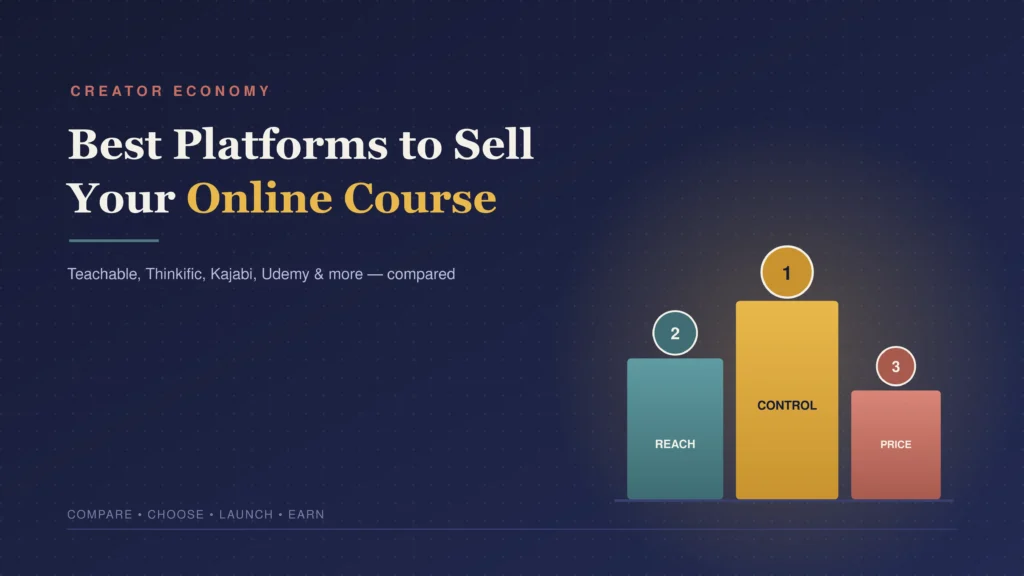
Choosing among the best platforms to sell online courses isn’t just a technical decision — it’s a business strategy decision. Marketplaces like Udemy and Skillshare offer speed and reach, while self-hosted platforms like Teachable, Thinkific, Kajabi, and Podia offer control, branding, and higher profit margins. The smartest move is to align your platform choice with how much traffic you already have, how premium your course pricing will be, and how much you want to own your student relationships long-term. Get that alignment right, and the platform becomes an asset that compounds your course sales for years to come.