When you work for yourself, there’s no manager assigning tasks, no coworker checking in, and no fixed schedule dictating your hours. Daily Routine for Solo Creators That freedom is exactly what drew most solo creators to this path — and it’s also exactly what makes so many of them burn out within the first year. Without an external structure, the responsibility for building one falls entirely on you. That’s why a solid daily routine for solo creators isn’t a nice-to-have. It’s the single biggest factor separating creators who last from creators who quietly disappear.
A good routine doesn’t mean rigid, joyless discipline. It means designing a day that protects your energy, your creative output, and your business — all without a boss standing over your shoulder to enforce it.
Why Solo Creators Need Routine More Than Anyone
Employees have structure built into their jobs: set hours, scheduled meetings, defined responsibilities. Solo creators have none of that by default. Every decision — when to work, what to work on, when to stop — is yours alone, all day, every day.
This unlimited freedom sounds appealing, but psychologically it’s exhausting. Constant decision-making drains mental energy, a phenomenon researchers call decision fatigue. A daily routine for solo creators removes hundreds of small decisions by making them once, in advance, instead of renegotiating your entire day every morning.
Routine also protects against the two extremes solo creators tend to swing between: overworking because there’s no one to tell you to stop, and underworking because there’s no one to notice if you don’t start. A clear daily structure keeps you out of both traps.
The Core Building Blocks of a Solo Creator’s Day
Before designing your own schedule, it helps to recognize the recurring categories that make up most creative businesses. A sustainable daily routine for solo creators typically includes:
- Deep creative work – writing, filming, designing, or building your core product
- Administrative tasks – invoicing, emails, planning, and business upkeep
- Audience engagement – responding to comments, messages, and community interaction
- Learning and growth – studying your craft, your niche, or your industry
- Rest and recovery – time that isn’t optimized for output at all
Most burned-out creators aren’t lacking effort — they’re lacking balance between these categories. A routine’s real job is to make sure none of them quietly disappears.
How to Build a Daily Routine That Actually Sticks
1. Anchor Your Day With a Non-Negotiable Start
You don’t need to wake up at 5 a.m. to be a “real” creator. What matters is starting your workday the same way each day — a short walk, coffee and journaling, a quick planning session — so your brain gets a consistent signal that work has begun.
2. Protect Your Best Hours for Your Hardest Work
Every solo creator has a window of peak focus, whether that’s early morning or late at night. Guard that window fiercely for your most demanding creative task. Save low-energy hours for admin work, replying to messages, or light editing.
3. Set Clear Start and Stop Times
One of the most common struggles solo creators face is knowing when to stop. Without a defined end time, work quietly bleeds into evenings and weekends. Pick a stopping point and treat it as seriously as you’d treat a client deadline.
4. Build in Buffer Time Between Tasks
Solo creators often stack tasks back-to-back with zero breathing room, then feel perpetually behind when something runs long. Short buffers between tasks absorb the inevitable overflow without wrecking your whole day.
5. Review and Adjust Weekly
A routine isn’t something you set once and follow forever. Revisit it weekly, notice what’s not working, and adjust. The goal isn’t a perfect schedule — it’s a sustainable one.
A Sample Daily Routine for Solo Creators
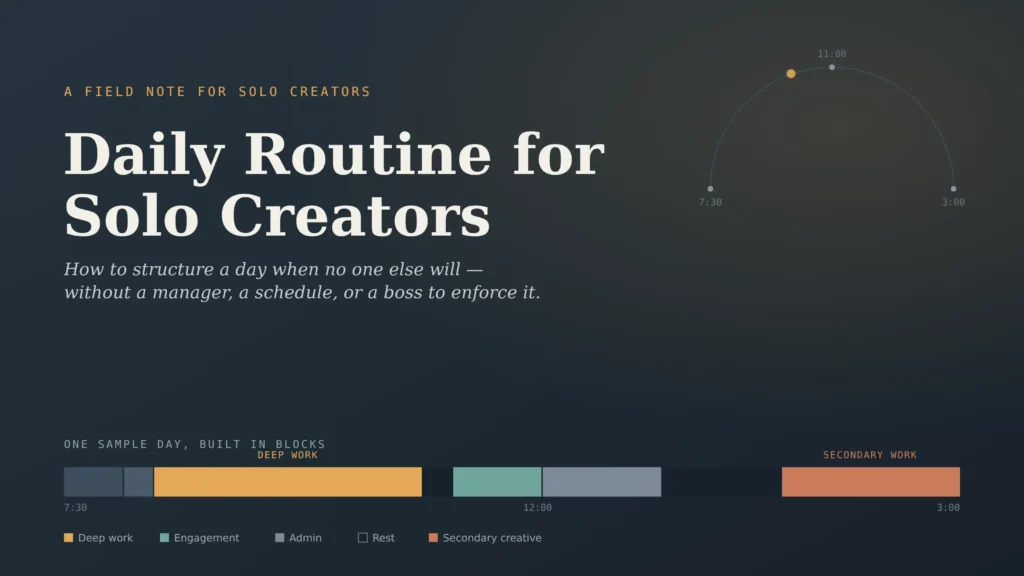
Every creator’s ideal day looks different depending on their niche, energy patterns, and life obligations, but here’s a realistic structure many solo creators build around:
- 7:30–8:00 AM – Morning routine, no screens
- 8:00–8:15 AM – Quick plan for the day’s priorities
- 8:15–10:30 AM – Deep creative work (writing, filming, or designing)
- 10:30–10:45 AM – Break
- 10:45–11:30 AM – Audience engagement and community replies
- 11:30–12:30 PM – Admin tasks and business emails
- 12:30–1:30 PM – Lunch and true rest, away from screens
- 1:30–3:00 PM – Secondary creative work or learning session
- 3:00 PM – Workday ends; personal time begins
Notice that rest isn’t squeezed into leftover minutes — it’s scheduled with the same intentionality as the work itself.
Common Routine Mistakes Solo Creators Make
Even well-intentioned creators sabotage their own routines in predictable ways:
- Treating every day as flexible. Total flexibility often becomes total inconsistency. Some structure, even loose structure, beats none.
- Skipping breaks because “there’s no one watching.” Breaks aren’t a reward for employees — they’re a requirement for sustainable output, solo or not.
- Never actually closing the workday. Without a clear stop time, work never fully ends, and creative energy never fully recovers.
- Copying someone else’s routine exactly. A schedule built for a morning person won’t work for a night owl. Build around your own energy, not someone else’s highlight reel.
Also Read
How to Batch Content Creation: Work Less, Publish More
Making Your Routine Sustainable for the Long Run
The real purpose of a daily routine for solo creators isn’t productivity for its own sake — it’s protecting the thing that makes your work possible in the first place: you. Creative businesses run on a limited, renewable resource, and that resource is your focus and energy, not just your hours.
A well-built routine won’t make every day feel effortless, but it will make most days feel manageable — predictable enough that you’re not white-knuckling your way through decisions from the moment you wake up. Start with one anchor point, one protected block of deep work, and one firm stopping time. The rest of the structure will build itself around those three pillars, one week at a time.