Figuring out how to price a digital product is one of the trickiest parts of launching an online business — and one of the most consequential. Price it too low, and you undervalue your work while training customers to expect discounts forever. Price it too high without justification, and you scare away buyers before they even see what you’ve built. Unlike physical goods, digital products have no shipping costs or manufacturing limits, which means the “right” price isn’t about covering material costs — it’s about communicating value. Here’s a practical framework to help you land on a price that feels fair to buyers and profitable to you.
Why Pricing Digital Products Is Different
With a physical product, cost-plus pricing is straightforward: add up materials, labor, and overhead, then tack on a margin. Digital products break that model entirely. An ebook, course, template, or software tool costs roughly the same to deliver to one customer as it does to ten thousand. That means your price isn’t tied to production cost — it’s tied to perceived value, transformation, and positioning.
This is both a challenge and an opportunity. Because your margins aren’t capped by materials, you have far more pricing flexibility than a physical product business does — but that flexibility only pays off if you understand what actually drives someone to click “buy.”
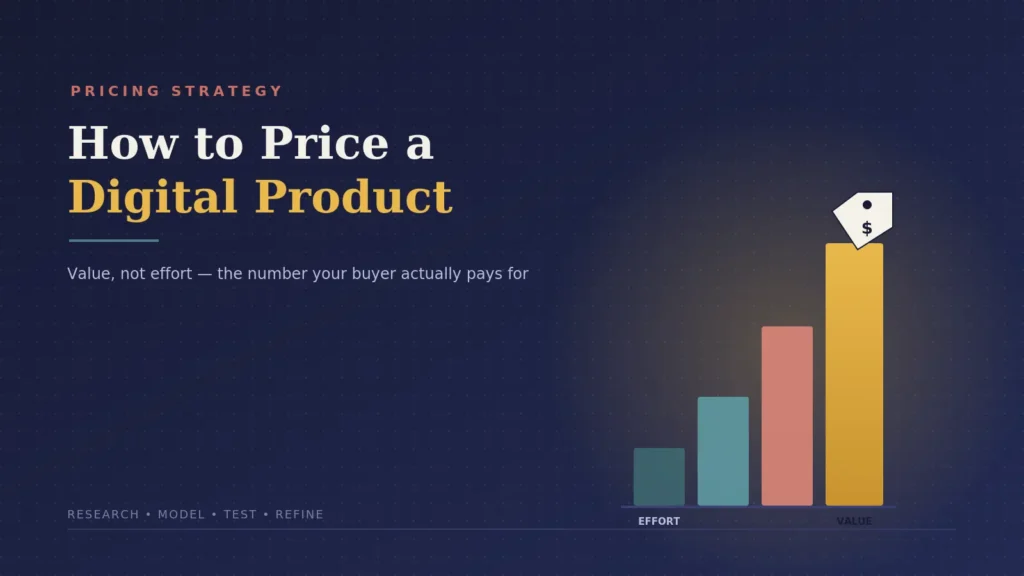
1. Start With the Value, Not the Effort
One of the biggest mistakes creators make is pricing based on how long something took to build rather than what it’s worth to the buyer. A template that took you two hours to design might save a customer twenty hours of work — meaning your price should reflect their time saved, not yours.
Ask yourself:
- What specific outcome does this product deliver?
- How much time, money, or stress does it save the buyer?
- What would they pay a freelancer or consultant to get the same result?
When you anchor pricing to outcomes instead of effort, you naturally move toward the value-based side of the spectrum, which almost always supports a higher, more sustainable price.
2. Research Comparable Products in Your Niche
Before settling on a number, look at what similar digital products are charging. This doesn’t mean copying competitors — it means understanding the price range your market has already accepted. If everyone in your niche charges $20–$40 for a similar ebook, pricing at $200 without a clear differentiator will likely stall sales, no matter how good your product is.
At the same time, don’t assume you need to match the cheapest option. A well-positioned product with better design, more depth, or added support can justify sitting at the top of that range — or beyond it.
3. Choose a Pricing Model That Fits Your Product
Not every digital product should be priced the same way. Consider which model fits your offer best:
- One-time payment – simple, ideal for templates, ebooks, and stand-alone courses
- Tiered pricing – offers a basic, standard, and premium option to capture different buyer segments
- Subscription – works well for ongoing tools, communities, or content libraries
- Pay-what-you-want – builds goodwill and audience trust, though it requires strong existing demand
- Bundle pricing – increases average order value by packaging multiple products together
Choosing the right structure is just as important as choosing the right number, since it shapes how customers perceive the offer’s flexibility and fairness.
4. Use Psychological Pricing Techniques
Small pricing decisions can meaningfully shift conversion rates. A few well-tested techniques worth applying:
- Charm pricing – $49 feels noticeably cheaper than $50, even though the difference is negligible
- Anchoring – showing a higher-priced tier next to your main offer makes the middle option feel more reasonable
- Decoy pricing – adding a slightly worse-value option makes your preferred tier stand out as the obvious choice
- Urgency and scarcity – limited-time pricing can accelerate decision-making, but should be used honestly to maintain trust
These techniques don’t replace strong value — they simply help communicate that value more persuasively at the moment of decision.
5. Test, Don’t Guess
Even with solid research, your first price is really a hypothesis. The smartest creators treat pricing as an ongoing experiment rather than a one-time decision. Track how conversion rates shift when you adjust pricing, run limited-time promotions to gauge demand elasticity, and pay attention to customer feedback about whether the price felt fair relative to what they received.
If you’re consistently converting at a very high rate with little resistance, that’s often a signal you’re underpriced. If you’re getting a lot of interest but few actual purchases, the issue may be price — or it may be that your value proposition isn’t clear enough yet.
6. Avoid the Most Common Pricing Traps
A few mistakes show up again and again among first-time digital product sellers:
- Pricing solely based on competitors without considering your own positioning
- Underpricing out of fear of rejection, then struggling to raise prices later
- Offering too many pricing tiers, which creates decision fatigue
- Failing to clearly communicate what’s included, leading buyers to underestimate value
- Never revisiting pricing after launch, even as the product or audience evolves
Avoiding these traps is often just as important as any specific pricing formula, since even a well-calculated price can underperform if the surrounding strategy is off.
Also Read
Best Platforms to Sell Online Courses in 2026
Final Thoughts
Learning how to price a digital product isn’t about finding one magic number — it’s about understanding the value you deliver, researching your market, choosing the right pricing structure, and staying willing to adjust as you learn more about your audience. Price with confidence rooted in the transformation your product provides, not just the hours it took to create. Get that mindset right, and pricing stops feeling like guesswork — it becomes one of the most powerful levers you have for sustainable, long-term revenue.