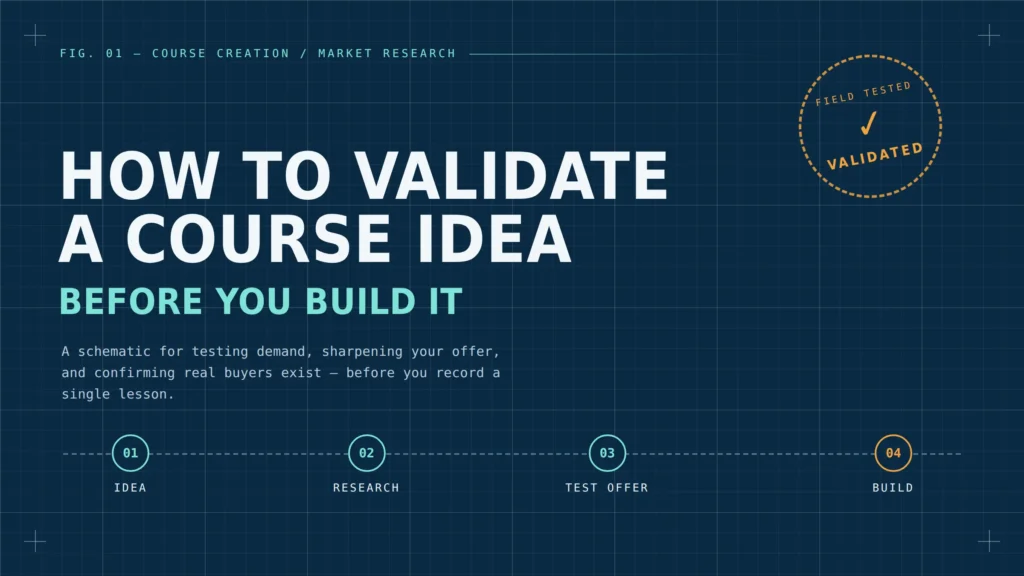
Every year, thousands of aspiring instructors pour weeks — sometimes months — into building online courses that nobody buys. How to Validate a Course Idea Before Building It The scripts get written, the slides get polished, the videos get recorded… and then the course launches to silence. The real problem isn’t the content quality. It’s that most creators skip a critical step: learning how to validate a course idea before building it.
Validation isn’t about being cautious for the sake of it. It’s about protecting your time, energy, and confidence by confirming — with real evidence, not assumptions — that people actually want what you’re planning to create. Below is a practical, no-fluff roadmap for testing your course concept before you invest a single hour in production.
Why Validation Matters More Than Motivation
Passion is a great starting point, but it’s a poor predictor of sales. You might be deeply excited about a topic, yet still discover that your target audience isn’t ready to pay for it, already has free alternatives, or wants a completely different angle than the one you imagined.
Validating your course idea before building it does three things:
- It saves you from wasted production time on a course nobody wants.
- It sharpens your messaging by showing you the exact words your audience uses to describe their problem.
- It gives you early buyers or beta testers who become your first testimonials and word-of-mouth promoters.
In short, validation turns guesswork into a repeatable, evidence-based process.
Step 1: Identify a Real, Specific Problem
The strongest courses solve a narrow, painful problem rather than a broad, vague topic. “Learn Photography” is a topic. “How to shoot sharp low-light portraits with a beginner DSLR” is a problem. The second version is easier to market, easier to price, and easier to validate because you can find people actively searching for that exact solution.
Start by listing three to five problems your potential students are currently struggling with. Ask yourself whether each one is urgent, recurring, and worth paying to solve. If the honest answer is “not really,” refine the idea before moving forward.
Step 2: Research Where the Conversation Already Exists
Before asking anyone directly, look at where your audience already talks about this problem. Reddit threads, Facebook groups, Quora questions, Amazon book reviews, and YouTube comment sections are goldmines of unfiltered feedback.
Look for patterns such as:
- Recurring questions that show up again and again
- Complaints about existing solutions being too basic, too advanced, or too expensive
- Phrases people use repeatedly — this becomes your marketing language later
If you find dozens of people asking the same question with no clear, structured answer available, that’s a strong signal your course idea has demand.
Step 3: Talk to Your Potential Students Directly
Online research tells you what people are saying publicly. Direct conversations tell you what they actually think and feel. Reach out to 10–15 people who fit your target audience and ask about their current struggles, what they’ve already tried, and what “success” would look like to them.
Avoid asking “Would you buy this course?” People are polite, and polite answers lie. Instead, ask about their past behavior: What have they already paid for? What did they abandon halfway through? What frustrated them about it? Past actions are far more reliable indicators than hypothetical intentions.
Step 4: Check What Already Exists in the Market
Competition isn’t a red flag — it’s proof of demand. If nobody else teaches this topic, that could mean untapped opportunity, or it could mean there’s no market at all. Search course marketplaces, YouTube, and search engines for similar offerings.
Pay attention to:
- Pricing — what are people already paying for similar content?
- Reviews — what do students say is missing or disappointing?
- Format — are competitors using video, text, cohort-based learning, or community access?
Your goal isn’t to copy competitors but to find the gap: the angle, depth, or delivery style that isn’t being served well yet.
Step 5: Create a Minimum Viable Offer
Once you’ve gathered enough signal that the problem is real and underserved, test it with a minimal version of your course before building the full thing. This could be a single paid workshop, a short mini-course, or even a detailed outline sold as a pre-launch offer with a discount for early buyers.
The key metric here is simple: are people willing to pay before the full product exists? If strangers (not just friends and family) hand over money for an outline and a promise, you have validated demand. If you can’t get anyone to commit even at a low price, that’s valuable information too — it means the idea needs repositioning, not more content.
Step 6: Measure Real Signals, Not Vanity Metrics
When validating a course idea before building it, be careful not to confuse attention with commitment. Likes, shares, and “sounds interesting!” comments feel encouraging, but they don’t predict sales. Focus instead on:
- Email sign-ups from a dedicated landing page
- Deposits or pre-orders for early access
- Attendance and engagement in a free workshop that pitches the paid course
- Direct replies asking “when can I buy this?”
These are the signals that separate genuine market interest from polite encouragement.
Also Read
How to Price a Digital Product Without Leaving Money on the Table
Turning Validation Into Momentum
Validating your course idea isn’t a one-time checkbox — it’s an ongoing conversation with your audience that continues even after launch. Each round of feedback refines your curriculum, pricing, and marketing message, making your eventual launch far stronger than if you had built blindly from day one.
The creators who succeed aren’t necessarily the ones with the most polished production value. They’re the ones who did the unglamorous work of listening first. If you take one thing away from this process, let it be this: build the course your audience has already told you they want, not the one you assumed they needed.