You have knowledge worth sharing, a growing audience, and a nagging question that won’t go away: course vs ebook, which to launch first? Course vs Ebook It’s one of the most common crossroads for creators, coaches, and subject-matter experts stepping into digital products for the first time. Choose wrong, and you might spend months building something your audience isn’t ready to buy. Choose right, and you set yourself up for faster revenue, stronger momentum, and a clearer path to your next product.
There’s no universal answer — but there is a smart way to think through it. This article breaks down the real differences between the two formats, the factors that should actually drive your decision, and a practical framework for figuring out which one deserves your attention first.
Why This Decision Feels So Hard
Both formats promise the same outcome: turning your expertise into income. But they demand very different investments of time, skill, and money, which is exactly why the course vs ebook debate causes so much hesitation.
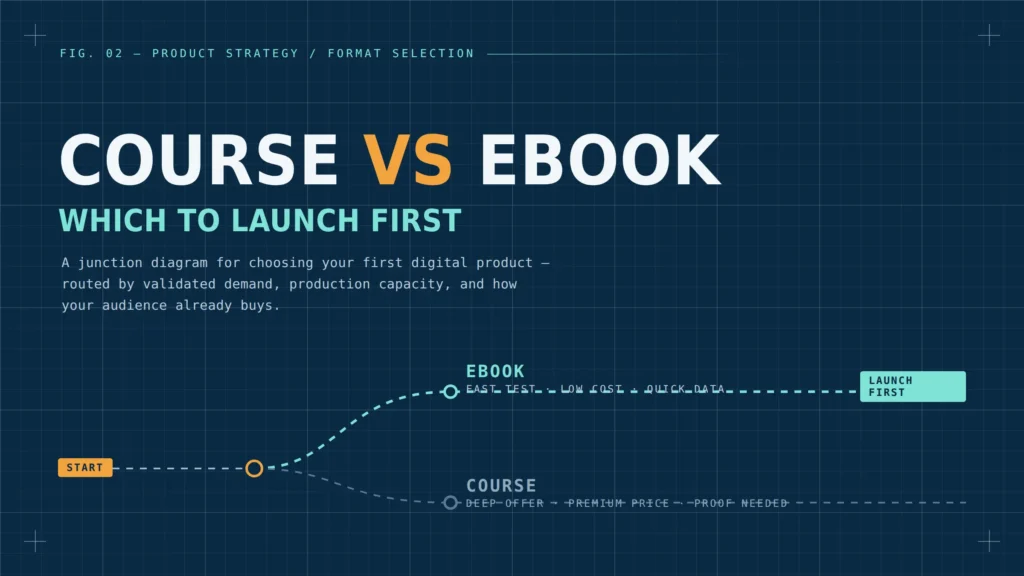
An ebook is fast to write, cheap to produce, and easy to price low. A course takes longer to plan, film, and edit, but commands a much higher price point and delivers a deeper transformation. Creators often assume the “bigger” product must be the better first move — but bigger isn’t always smarter when you’re just starting out.
What an Ebook Does Best
Ebooks are the lightweight option, and that’s their biggest strength. If you’re testing whether people will pay for your specific knowledge, an ebook lets you find out with minimal risk.
Here’s where an ebook typically wins:
- Speed to market — you can outline, write, and format an ebook in days or weeks, not months.
- Low production cost — no filming, editing, or hosting platform required.
- Easy to validate demand — a $9–$29 price point is an easy “yes” for buyers, giving you fast data on what content resonates.
- Simple to update — a Google Doc or Canva file can be revised in an afternoon if feedback shows something needs fixing.
The tradeoff is depth. Ebooks are read passively, with no built-in accountability, community, or step-by-step guidance. They’re excellent for delivering a framework, a mindset shift, or a specific answer — but weaker for complex skills that require practice, feedback, or sequential learning.
What a Course Does Best
A course is a bigger commitment on both sides of the transaction. Students pay more because they’re investing in structured guidance, multimedia teaching, and often direct access to you. In return, you invest significantly more time in planning modules, recording video, building assessments, and possibly running live sessions.
Courses tend to be the stronger choice when:
- The topic involves a skill that benefits from demonstration, not just explanation (think design software, public speaking, or fitness form).
- Your audience needs structure and pacing rather than a single burst of information.
- You want to build a premium offer with pricing that reflects transformation, not just content.
- You already have proof that people want this topic — through pre-orders, waitlists, or a validated ebook.
Because a course is more expensive to build and to buy, it also carries more risk if the topic hasn’t been tested with a real audience yet.
The Framework: Let Your Audience Answer the Question
Instead of guessing, use these four questions to decide which format to launch first.
1. Have you validated demand yet?
If you haven’t already confirmed that people want this topic, start with the ebook. It’s a low-cost way to prove the market exists before committing to a bigger production.
2. Does the topic require demonstration or practice?
If success depends on watching a process unfold — a technique, a workflow, a physical movement — a course will teach it far more effectively than text and static images ever could.
3. How much production time do you realistically have?
Be honest about your bandwidth. A rushed course with poor audio, disorganized lessons, and no clear structure will hurt your reputation more than a well-crafted ebook ever would.
4. What’s your audience’s buying behavior?
Look at what they’ve purchased before. Audiences accustomed to buying $500 programs are primed for a course. Audiences used to $15 guides may need to be warmed up first with a lower-cost product.
A Smart Sequencing Strategy
Many successful creators don’t choose one format over the other — they sequence them strategically. A common and highly effective path looks like this:
- Launch a focused ebook to validate the topic and start generating revenue quickly.
- Use ebook sales data and reader feedback to refine your messaging and identify gaps.
- Build a course that expands on the ebook’s core framework with deeper implementation support.
- Offer the ebook as a lead magnet or low-cost entry point into your course funnel.
This approach reduces risk at every stage. Instead of gambling months of production time on an unproven idea, you’re building a ladder of trust — each product setting up the next one for a stronger launch.
Also Read
How to Validate a Course Idea Before Building It
Making the Final Call
If you’re still torn between course vs ebook and which to launch first, default to the smaller, faster option when demand is uncertain, and reserve the course for topics you’ve already proven people are willing to pay to master.
The goal isn’t to pick the “better” format in the abstract — it’s to pick the format that matches where you are right now: your audience’s trust level, your production capacity, and how much proof you already have that this idea works. Start small, listen closely to what your buyers tell you, and let that evidence — not assumption — decide what you build next.